If your air conditioner's outdoor unit is sitting there dead while the inside still hums along, there's a good chance the problem is a part smaller than your fist. It's called the capacitor, and it's one of the most common AC repairs we run all summer here on the Treasure Coast.
I'll walk you through how to spot a bad AC capacitor, why they give out so fast in Florida, what replacement runs, and how to tell when the dead outdoor unit is something else entirely. I replace these things constantly between May and October, so this comes from the field, not a brochure.
Your outdoor unit is dead but the inside is running — start here
Here's the scenario almost every capacitor call starts with: the thermostat is set, the indoor blower is moving air, but the big unit outside is silent. No fan spinning. Maybe a faint hum if you stand next to it.
I had this exact call over in PGA Village in Port St. Lucie. Guy had people coming over, the house was warming up, and he met me in the driveway hoping it wasn't going to be a whole ordeal. Indoor unit running, outdoor unit dead. I checked the starting circuit and found a capacitor swollen up on top. Swapped it, checked the amp draw, and the compressor kicked right back on. (You can read that whole call on our Port St. Lucie AC repair page.)
When the inside works and the outside doesn't, the capacitor is the first thing a good tech checks. Here's why.
What an AC capacitor actually does
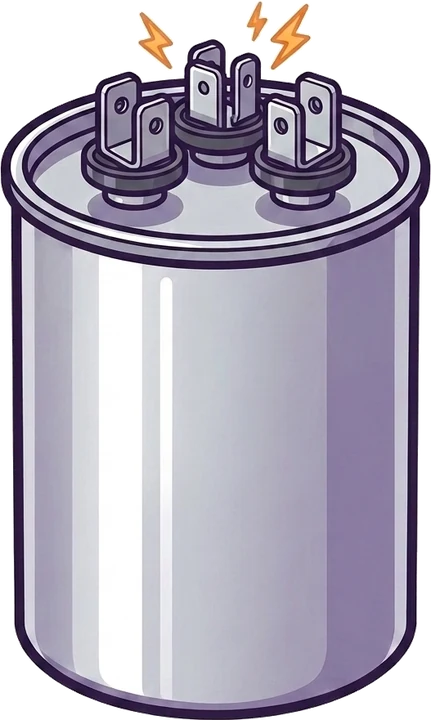
Think of the capacitor as the jump start for your AC. Your compressor and the outdoor fan motor both need a big jolt of energy to get spinning, and then a steady nudge to keep going. The capacitor stores that energy and releases it on demand.
Most outdoor units use a dual run capacitor that handles both the compressor and the fan. When it weakens, those motors either struggle to start or don't start at all. The motor is fine. The thing that's supposed to kick it into motion has given up.
That's the part people get wrong. They hear "the AC won't turn on" and assume the worst — a dead compressor, a whole new system. Most of the time it's a twenty-dollar part doing a hundred-dollar job badly.
6 signs of a bad AC capacitor
Here's what I look for, and what you can notice yourself before you ever call:
- The outdoor unit hums but the fan won't spin. Classic weak capacitor. The motor wants to go and can't get over the hump. (Don't grab a stick and spin the fan to "help it" — that's an old trick that can hurt you and only confirms what a meter already tells me.)
- The AC won't turn on at all, even though the indoor blower is still running normally.
- The top of the capacitor is swollen or bulging. A healthy capacitor has a flat top. When the top domes up or leaks, it's done. This is the one homeowners can sometimes spot themselves.
- The system cools on and off or short-cycles. It starts, runs a bit, struggles, shuts down, tries again.
- Hard starts — a clunk or a click and a hesitation before the unit finally kicks on. That's the capacitor straining to do its job.
- Your electric bill creeps up for no obvious reason. A failing capacitor makes the motors work harder and pull more power.
One or two of these and it's worth a look. A swollen top, and you already have your answer.
Why capacitors fail faster in Florida
This is the part that surprises people who moved down from up north. Capacitors are rated for heat, but South Florida pushes them harder than almost anywhere.
Three things stack up against them here:
Heat load. Our cooling season runs the better part of the year. A capacitor in Port St. Lucie logs way more run hours than one in a place that only needs AC three months a year. Capacitors are rated in hours of operation, and ours burn through them fast.
Sustained high temperatures. The capacitor lives inside the outdoor unit, baking in the Florida sun on top of the heat the system itself throws off. Electrolytic parts hate that. The hotter they run, the shorter they live.
Storm power surges. Our afternoon thunderstorms and the flicker-and-restore power events that come with them are rough on every electrical component in the system. A capacitor that was already weak often gives out the day after a storm rolls through.
Up north a capacitor might last a decade. Down here, seeing one fail in five to seven years is normal, sometimes sooner on a unit that runs hard.
Can you replace an AC capacitor yourself?
I'll be straight with you: technically it's a small part, but I don't recommend it, and here's the honest reason why.
A capacitor stores an electrical charge even after you cut the power to the unit. If you open the panel and touch the terminals wrong, that stored charge can hurt you. It has to be discharged safely first.
On top of that, capacitors are matched to your system by microfarad (µF) rating and voltage. Put in the wrong one — even one that looks identical — and you can burn out the very compressor you were trying to protect. That twenty-dollar fix turns into a several-thousand-dollar one in a hurry.
If you're comfortable around live electrical components and you know how to discharge a capacitor and read the rating off the old one, you have the parts knowledge. If any of that gave you pause, that's your sign to have a tech handle it. We get to most of Port St. Lucie same-day, and the diagnosis takes minutes.
What AC capacitor replacement costs
A straightforward capacitor replacement is one of the cheaper AC repairs out there. For most homeowners it lands somewhere in the low-to-mid hundreds installed, depending on the part rating, whether it's an after-hours or weekend call, and what else the tech finds while they're in there.
The number that matters more is what it saves you. When a capacitor goes weak and you keep running the system, it forces the compressor to strain on every start. Do that long enough and you risk the compressor itself — which is the most expensive part of the whole unit. Catching the capacitor early is the difference between a small bill and a system replacement.
That's the conversation I had with the PGA Village customer. He got lucky. If that swollen capacitor had kept hammering the compressor, we'd have been talking about a much bigger repair.
When a dead outdoor unit isn't the capacitor
Capacitors are the usual suspect, not the only one. If the part looks fine and tests in range, I keep going down the list:
- A tripped breaker or a blown fuse at the disconnect outside
- A failed contactor — the switch that sends power to the compressor
- A bad fan motor or compressor (less common, more expensive)
- A thermostat or low-voltage wiring issue telling the unit to stay off
If your AC is running but not actually cooling the house — as opposed to the outdoor unit being flat-out dead — that's a different troubleshooting path. We walk through that one here: how to troubleshoot an AC that's not cooling properly.
When to call a Port St. Lucie AC tech
If your outdoor unit is dead, the top of your capacitor is swollen, or the house is heating up and you've got people coming, that's a same-day call. We dispatch out of St. Lucie West and reach PGA Village, Tradition, and the rest of the city fast, every repair is backed by our warranty, and you can book online in about seven seconds.
Call (772) 238-6238 or [schedule AC repair in Port St. Lucie](/schedule-service/). If it's already hot and getting worse, head straight to our [emergency AC repair](/ac-repair/emergency/).
Frequently asked questions
How do I know if my AC capacitor is bad? The most reliable signs are an outdoor unit that hums but won't spin, a unit that won't start at all while the indoor blower still runs, and a capacitor with a swollen or bulging top. A tech can confirm it in minutes with a meter that reads the part's microfarad rating against spec.
How long do AC capacitors last in Florida? Five to seven years is typical here, and sometimes less. Our long cooling season, constant heat, and storm-related power surges wear capacitors out faster than in cooler climates where the AC only runs a few months a year.
How much does AC capacitor replacement cost in Port St. Lucie? It's one of the more affordable AC repairs — usually in the low-to-mid hundreds installed, depending on the part rating and whether it's an after-hours call. Replacing it early also protects your compressor, which is the costliest part of the system to replace.
Is it safe to run my AC with a swollen capacitor? No. A swollen capacitor is already failing, and running the system forces the compressor to strain on every start. That extra strain can damage the compressor and turn a small repair into a major one. Shut the system off and have it looked at.
Kyzar Air Conditioning Serving West Palm Beach, Port St. Lucie, and the Treasure Coast.
Port St. Lucie Office 145 NW Central Park Plaza STE 108, Port St. Lucie, FL 34986 (772) 238-6238
West Palm Beach Office 2636 Old Okeechobee Rd, West Palm Beach, FL 33409 (561) 203-3788
Schedule Service · Port St. Lucie AC Repair · Emergency AC Repair