Here's a call I get all summer: the AC is running, the thermostat says 72, but the house feels sticky, heavy, and there's a faint musty smell every time the air kicks on. The homeowner is confused because the number on the wall looks right. The temperature isn't the problem. The moisture is.
Down here in Port St. Lucie, your AC isn't fighting heat so much as it's fighting humidity, and when a system stops pulling water out of the air the way it should, you feel it before you can explain it. Let me walk you through what's actually going on, using two real calls from this past season.
The thermostat doesn't tell the whole story
I had a maintenance call over in Tesoro Club. Big, clean home, nothing obviously wrong. The homeowner met me at the door: "I don't know what's happening, it says 72 on the thermostat, but the house feels gross and kind of smells musty."
That's the tell. A thermostat reads temperature, not moisture. Your AC is supposed to do two jobs at once — cool the air and wring the humidity out of it. When the second job slips, the air can hit 72 degrees and still feel like a wet towel. That damp air is also what feeds the musty smell, because moisture sitting on the wrong surfaces is exactly where mildew likes to grow.
So the smell and the sticky feeling usually come from the same root cause: water staying inside the system where it shouldn't.
What I actually find causing the musty smell
When I opened up that Tesoro Club system, nothing was dramatic. It was a stack of small things adding up:
- A dirty filter choking the airflow
- A drain line starting to back up, so condensation wasn't clearing
- Buildup on the evaporator coil — the cold coil where moisture collects
None of that throws an error code. The unit keeps running. But a dirty coil and a sluggish drain mean water lingers, the system can't dehumidify, and you get that damp, musty air moving through every vent.
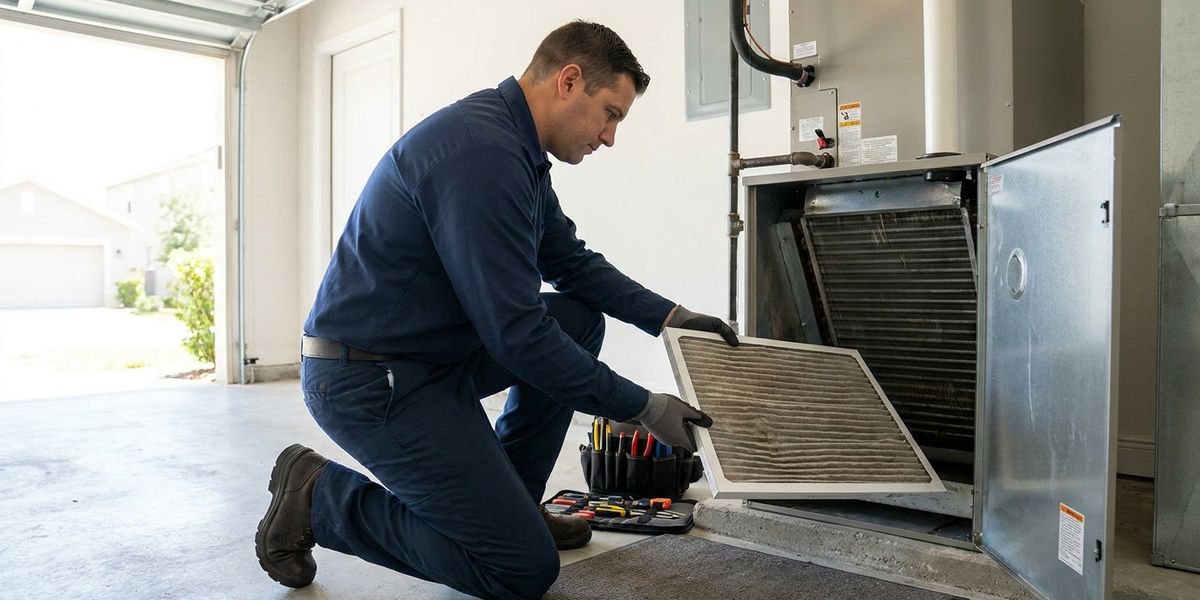
A few weeks later I had a similar call over in Riverland — homeowner waking up stuffy and congested, sure that something in the house was making her feel off. She kept the place spotless, changed her filter, vacuumed constantly. When I checked the air handler, here's what I found:
- A cheap, thin filter that wasn't catching much
- A UV light that had burned out and wasn't treating the coil anymore
- A drain pan that kept staying wet
- Early buildup forming around the coil cabinet
I told her the same thing I tell everyone in that spot: this doesn't mean your house is dirty. It means your AC system is moving damp, dirty air around the house. That's a system problem, not a housekeeping problem.
The fix is rarely one magic product
People want there to be a single gadget that solves musty air. Sometimes a product helps, but the real fix is getting the system back to doing its job. On both of those calls, the work looked like this:
- Cleaned the evaporator coil and the cabinet area
- Flushed the drain line and cleared the pan
- Checked the float switch so a future clog can't overflow
- Replaced the filter with one that actually filters — without choking airflow
- Replaced the dead UV bulb (in the Riverland home)
- Checked refrigerant pressures and looked over the electrical while I was in there
After the Tesoro Club system ran for a little while, the homeowner noticed it on her own. "It already feels different in here." Not colder. Cleaner and drier. That's the dehumidification coming back online.
One filter mistake that makes it worse
Quick warning, because I see this constantly: don't grab the thickest, densest filter on the shelf and assume more is better. If your system isn't set up for it, a super-restrictive filter chokes airflow and can actually hurt performance. On the Riverland call I checked the static pressure before recommending a filter, because the right filter is the one your system can actually pull air through. Match the filter to the equipment, not to the marketing on the box.
Why your fan setting might be feeding the humidity
This one surprises people. If your thermostat fan is set to ON, the blower runs nonstop, even after the cooling cycle stops. That sounds efficient, but here's the catch: after the AC shuts off, the coil is still wet. Running the fan across a wet coil blows that moisture right back into the house instead of letting it drain away.
In a dry climate that's fine. In Port St. Lucie, it can quietly work against you. Switching the fan to AUTO lets the coil drain between cycles. It's a free change you can make tonight, and on humid days you'll feel the difference.
Why this hits harder in Port St. Lucie
We live in one of the most humid corners of the country, and our newer neighborhoods — Tradition, Riverland, St. Lucie West, Tesoro — are surrounded by water and greenery. You're not far from the North Fork of the St. Lucie River and all the natural humidity that comes with it. Pollen and moisture are part of life here.
That's exactly why a system that's even slightly behind on maintenance shows up as musty, sticky air so fast. The humidity load never really lets up from May through October. A coil that would stay clean for two years up north needs more attention here. Keeping up with maintenance isn't busywork in this climate — it's the difference between air that feels fresh and air that feels like a damp basement.
When to call a Port St. Lucie AC tech
A little musty smell at startup that fades is sometimes just moisture in the line. But if the smell sticks around, the house feels humid with the AC running, or you're waking up congested, that's the system asking for help. A maintenance visit catches the dirty coil, the slow drain, or the dead UV light before they turn into a bigger problem on a 95-degree day.
We dispatch from St. Lucie West and cover Tradition, Riverland, Tesoro, PGA Village, and the rest of the city. Call (772) 238-6238 or [schedule an AC maintenance visit in Port St. Lucie](/schedule-service/). If musty, damp air is the main thing bothering you, our [indoor air quality](/indoor-air-quality/) options work hand in hand with a good tune-up.
Want to keep this from coming back every summer? Regular [AC maintenance in Port St. Lucie](/service-areas/port-st-lucie/ac-maintenance/) is the cheapest insurance there is against musty air and surprise breakdowns.
Frequently asked questions
Why does my AC smell musty when it turns on? A musty smell at startup usually means moisture is sitting somewhere it shouldn't — most often on a dirty evaporator coil or in a drain pan that isn't clearing. Damp surfaces inside the air handler grow mildew, and the smell pushes into the house when the blower kicks on. Cleaning the coil and flushing the drain typically clears it.
Why is my house humid even though the AC is running? Your AC cools and dehumidifies at the same time. If the coil is dirty, the filter is clogged, or the drain is backing up, the system can still hit the set temperature while doing a poor job pulling moisture out of the air. The fix is restoring airflow and drainage so the system can dehumidify again.
Should my AC fan be set to ON or AUTO in Florida? In humid Florida, AUTO is usually better. On ON, the blower runs after the cooling cycle ends and blows moisture off the still-wet coil back into the house. AUTO lets the coil drain between cycles, which keeps indoor humidity lower.
How often should I get AC maintenance in Port St. Lucie? At least once a year, and twice is better in our climate given how long the cooling season runs. Regular maintenance keeps the coil clean and the drain clear, which is what prevents musty smells, high humidity, and mid-summer breakdowns.
Kyzar Air Conditioning Serving West Palm Beach, Port St. Lucie, and the Treasure Coast.
Port St. Lucie Office 145 NW Central Park Plaza STE 108, Port St. Lucie, FL 34986 (772) 238-6238
West Palm Beach Office 2636 Old Okeechobee Rd, West Palm Beach, FL 33409 (561) 203-3788
Schedule Service · Port St. Lucie AC Maintenance · Indoor Air Quality