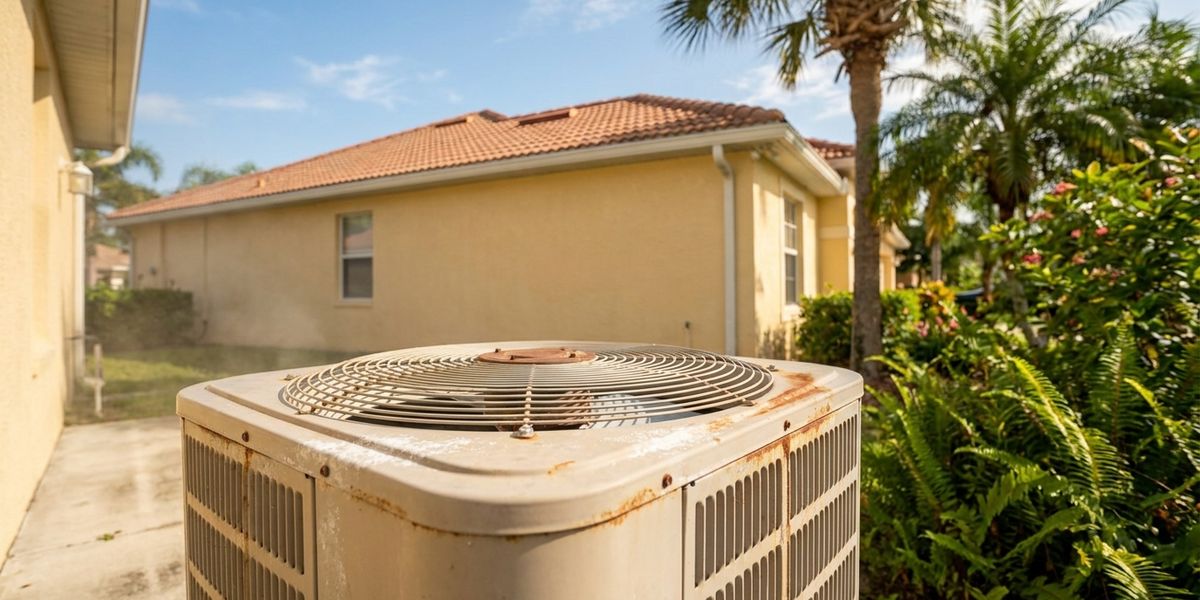
You walk out to the side of the house on a July afternoon in West Palm Beach, and something feels off. You can hear your outdoor unit humming, but the big fan on top isn't turning. Meanwhile, inside, the air coming from the vents is warm and getting warmer. That combination is your system quietly telling you it's in trouble.
A condenser fan that won't spin is one of the most common calls we get from Riverside to St. Lucie West, and here's the thing you need to know right away: if the unit is humming but the fan isn't moving, keep reading before you do anything else. That specific symptom points to a part that's cheap to replace but expensive to ignore.
What the Outdoor Fan Actually Does
The fan on top of your outdoor condenser has one job, and it's a big one. It pulls air across the condenser coil to dump the heat your system just pulled out of your house. In South Florida, where the compressor runs eight or nine months a year and barely rests overnight in summer, that fan is doing real work every single day.
When the fan stops, heat has nowhere to go. Pressures climb, the compressor overheats, and the system either shuts itself down on a safety limit or, worse, cooks the most expensive component you own. That's why a stalled fan is never a "wait and see" problem down here.
The "Hum but No Spin" Test
Here's the single most useful thing you can do. If your unit is humming or buzzing but the fan blade is dead still, turn the thermostat off, then grab a long stick, a broom handle, or a wooden dowel. Never use your hand. Reach through the top grille and give the fan blade a gentle nudge.
If it takes off and keeps spinning on its own, you've almost certainly got a failed run capacitor. The motor is fine; it just doesn't have the electrical "kick" it needs to start turning. If it spins a little and stalls, or does nothing at all, the problem is likely the motor itself or the wiring feeding it.
Either way, shut the system off after the test. Running a unit that can't start its own fan will overheat the compressor within minutes.
The Usual Suspects, From Cheap to Costly
A Failed Capacitor (the most common cause)
Capacitors are the number one reason an AC fan won't start in our service area, and the relentless heat is exactly why. That little cylinder stores the jolt of energy that gets both the fan and the compressor moving. Florida's year-round runtime and attic-level temperatures bake them out fast, often in five to eight years instead of the ten-plus you'd see up north. A swollen top or a rusty leak on the capacitor is a dead giveaway. If you want to know what to look and listen for, our guide to bad AC capacitor symptoms in Florida walks through it in detail.
A Bad Fan Motor
If the capacitor tests fine but the fan still won't turn, the motor bearings may have seized or the windings may have burned out. Salt air off the coast is brutal on motor bearings, and units near the Intracoastal or out toward the Treasure Coast beaches tend to lose motors sooner. A motor that hums, gets hot, and trips the breaker is usually done.
A Tripped Breaker or Blown Fuse
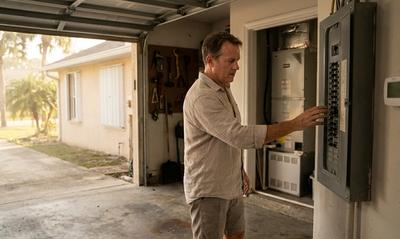
Sometimes the fix is genuinely simple. Check your electrical panel and the disconnect box on the wall next to the outdoor unit. A breaker that tripped during an afternoon storm surge can leave the fan dead. Reset it once. If it trips again immediately, stop, because something downstream is drawing too much current, and that's a call for a technician.
A Failed Contactor
The contactor is the electrical switch that sends power to the fan and compressor when the thermostat calls for cooling. Its contacts pit and corrode over time, and our humidity speeds that along. A contactor that won't close means the fan never gets power in the first place.
Debris Jamming the Blade
Grass clippings, a stray palm frond, or a lovebug swarm caked onto the blade can physically stop the fan. So can a wasp nest built inside the housing over a quiet weekend. With the power off at the disconnect, look for anything obvious binding the blade.
Burned or Chewed Wiring
Rodents love the warm, dry space inside a condenser, and they chew wiring. Corroded or burned connections in that salty coastal air can also break the circuit. If you see melted insulation or scorch marks, don't touch it. Shut it off.
Shut It Off. Here's Why That Matters.
We can't say this strongly enough. The moment you notice the fan isn't spinning, turn the system off at the thermostat and, ideally, at the outdoor disconnect. A compressor that runs without airflow across the coil can overheat in as little as ten to fifteen minutes in July heat. Replacing a capacitor is a modest repair. Replacing a compressor often means it's time to weigh repairing versus replacing the whole unit. Protecting the compressor is worth the temporary discomfort.
DIY vs. Calling a Pro
You can safely check the breaker, inspect for obvious debris with the power off, and do the stick test to narrow down the cause. That's the DIY line.
Everything past that involves capacitors that hold a dangerous charge even when the power is off, plus line-voltage wiring. Capacitors have sent plenty of well-meaning homeowners to the ER. A technician can safely discharge and test the capacitor, verify the motor and contactor, and get you cooling again, usually in one visit. If your fan trouble came alongside other symptoms, our guides on why your AC isn't cooling and why your AC keeps making noise can help you describe what's happening.
Frequently Asked Questions
Can I just run my AC with the outdoor fan not spinning?
No. Please don't. Without that fan moving air across the coil, the compressor overheats fast and can fail permanently within minutes on a hot day. Shut the system off and get it looked at before you run it again.
How much does it cost to fix a condenser fan that won't spin?
It depends entirely on the cause. A capacitor replacement is one of the more affordable repairs. A new fan motor costs more, and a contactor falls in between. A technician can diagnose it in one visit and tell you exactly which part failed before any work begins.
Why do capacitors fail so often in Florida?
Heat is the enemy of capacitors, and we have plenty of it. Year-round runtime, high attic and outdoor temperatures, and long summer cycles wear them out faster here than almost anywhere in the country. Five to eight years is a realistic lifespan in our climate.
The fan spins when I push it with a stick. What does that mean?
That's the classic sign of a weak or failed capacitor. The motor works, but it can't generate the startup torque on its own. Turn the unit off after the test and schedule a capacitor replacement; running it this way strains the compressor.
Could a storm have caused this?
Absolutely. Power surges from summer lightning, tripped breakers, and debris blown into the unit are all common after South Florida storms. Check the breaker and disconnect first, but if the fan still won't turn, it's worth a professional look.
Whether you're in West Palm Beach or up in Port St. Lucie, Kyzar Air Conditioning runs same-day service out of both offices, so a stalled fan doesn't have to turn into a ruined compressor. We'll diagnose the exact cause, protect your system, and get you cool again. Book your repair, learn more about our AC repair service, or see details for West Palm Beach AC repair and Port St. Lucie AC repair.